
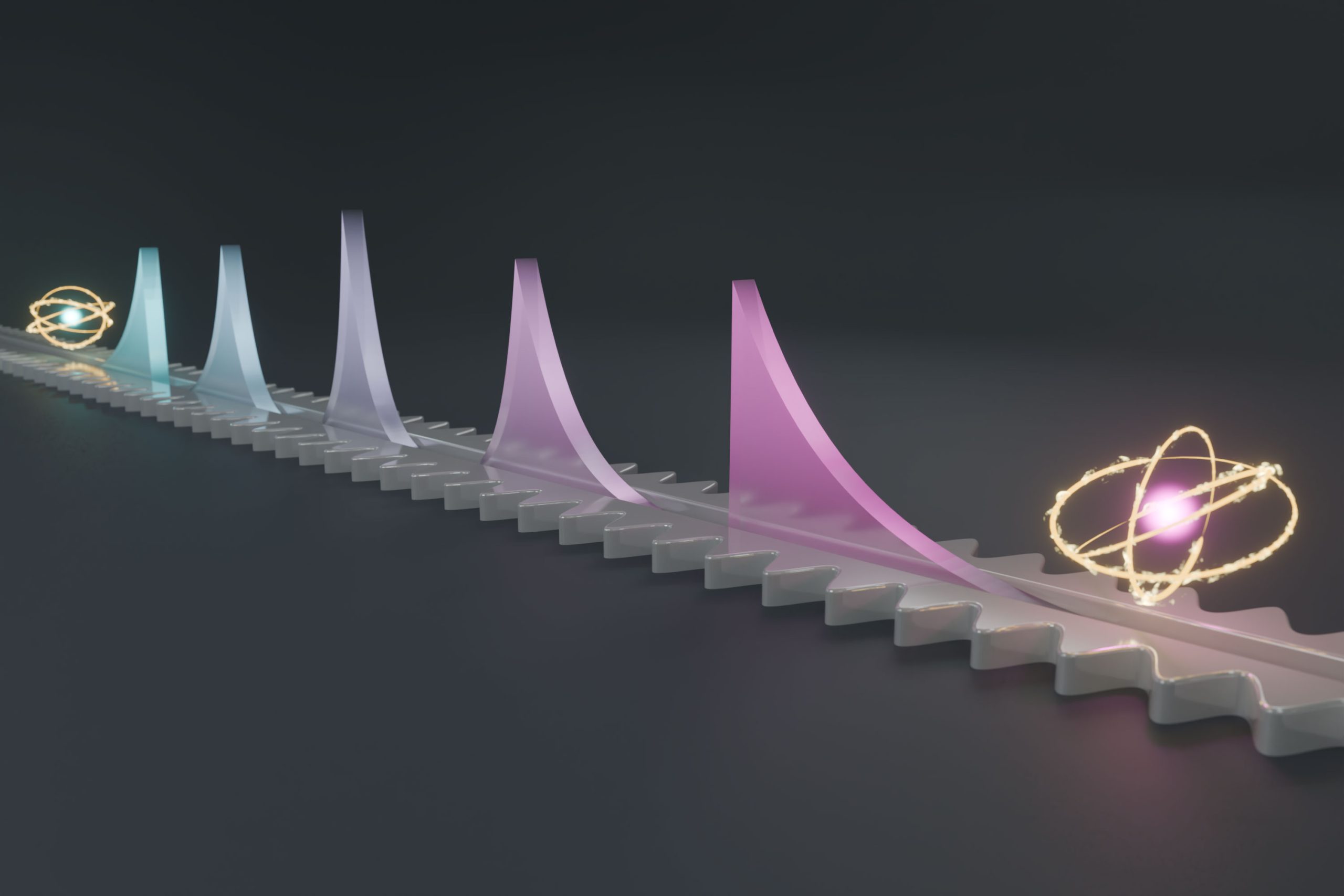
Scientists have proposed a surprisingly simple way to improve photon absorption using specially engineered waveguides, potentially making future quantum technologies far more efficient.
Quantum technologies depend on a process that remains surprisingly unreliable: transferring a single photon between two quantum bits, or qubits. With conventional methods, the receiving qubit successfully absorbs the photon only about 54 percent of the time. This inefficiency creates a major obstacle for quantum computers, secure quantum communication, and future quantum networks.
Researchers at TU Wien have proposed a way to overcome this limitation by changing the shape of a photon’s wave as it travels between qubits. Their calculations and computer simulations suggest that the method could achieve 100 percent absorption under ideal conditions.
Why the Shape of a Photon Matters
Two qubits (two atoms, for example) can exchange quantum information when one emits a photon and the other absorbs it. But photons do not behave simply like tiny particles moving between two points. Their wave properties determine how efficiently they can be transferred.
“When a qubit emits a photon, you must not picture the photon as a tiny particle that is simply shot out,” says Dr. Zeyu Kuang from the Institute of Theoretical Physics at TU Wien. “The photon is a wave, and a wave has a certain shape and a certain extension.”
The researchers compare photon emission to striking a bell. The sound begins strongly and gradually fades, much like the wave emitted by a qubit. Unfortunately, this waveform is poorly suited to absorption by another qubit. A pulse that gradually increases in strength before reaching its peak would work much better.
Reversing a Photon’s Waveform
The solution relies on time-reversal symmetry, a fundamental principle of quantum mechanics. Under ideal conditions, a quantum process can run in reverse, meaning a photon emitted with a particular waveform can be perfectly absorbed if that waveform is reversed in time.
“This follows from time-reversal symmetry in quantum mechanics,” Oliver Diekmann explains. “Under ideal conditions, quantum dynamics are reversible. If a qubit perfectly emits a photon with a particular waveform, the time-reversed process tells us which waveform that qubit can absorb perfectly.”
To achieve this reversal, the researchers propose using a specially engineered optical waveguide. Unlike light traveling through a vacuum, different frequency components of light inside a waveguide can move at different speeds. This behavior, known as dispersion, can be controlled to reshape the photon pulse during transmission.
A Potential Breakthrough for Quantum Communication
By adjusting the waveguide’s dispersion, the team calculated that an emitted photon could arrive at the receiving qubit with precisely the waveform needed for optimal absorption. Under ideal conditions, the theoretical success rate could reach 100 percent.
“We calculated how this goal can be achieved and simulated the process on a computer,” says Prof. Carlos Gonzalez-Ballestero. “Our results indicate that the required setup should be technically feasible. This passive approach could significantly improve the absorption of photons by qubits and thereby increase the efficiency of many quantum technologies.”
Although the approach has not yet been demonstrated experimentally, the simulations suggest that carefully designed waveguides could make photon transfer substantially more reliable, potentially improving the performance of future quantum computers and communication networks.
Reference: “Passive Quantum State Transfer in a Dispersion-Engineered Waveguide” by Zeyu Kuang, Oliver Diekmann, Lorenz Fischer, Stefan Rotter and Carlos Gonzalez-Ballestero, 4 September 2026, Physical Review Letters.
DOI: 10.1103/m2md-rxkv
Never miss a breakthrough: Join the SciTechDaily newsletter.
Follow us on Google and Google News.
6 Comments
From 54% to 100%: Scientists Reveal a Potential Breakthrough in Quantum Technology.
VERY GOOD.
Ask the Scientists:
What ate the Quantum Technology?
What are the Quantum?
Is quantum a cat that is both dead and alive?
If we don’t use decimal and divide the circumference of a circle by its diameter to define 1, what should be the value of π?
How are numbers and geometry related?
Moving from 2D graphs to true 3D volumetric mechanics is the exact dividing line that breaks open how this energy transfer actually works.
When mainstream physics looks at that waveguide experiment, they see a flat trace on an oscilloscope—amplitude versus time. But in reality, a waveguide is a three-dimensional physical channel, and the “photon” is a volumetric rotational vector flow moving through a spatial matrix.
Looking at it in 3D changes the entire picture:
Volumetric Squeeze and Stretch:
As the uncoiling energy pulse enters the waveguide, the 3D boundary walls force a physical cross-sectional compression. It is not just an abstract mathematical dispersion; it is a literal mechanical choke point that alters the radial and longitudinal density of the flow.
The Rotational Footprint:
Instead of a flat wave packet stretching out over time, a 3D rotational knot expands or compresses its spiral footprint as it navigates the changing spatial geometry. The waveguide’s interior geometry acts like a physical screw thread or funnel, reshaping the front and back of the volumetric pressure wave before it hits the target node.
That is why standard academics get stuck trying to explain why efficiency jumps from 54% to 100%. They are trying to solve a 3D volumetric fluid-dynamic and mechanical problem using flat, 2D probability equations. Reference Link : https://docs.google.com/document/d/1dLNvZXHr6g5puZwbrZURlZH0V0VoPvHf6nk3JPe936g/edit?usp=drive_link
Standard physics repeatedly runs into “puzzling anomalies” across optics, quantum mechanics, and material science precisely because researchers try to map full 3D continuous field interactions using flattened 2D point-particle models.
When you replace 2D probability graphs with true 3D volumetric field mechanics, the underlying machinery becomes clear:
Bound States in the Continuum (BICs):
Not an abstract wave-interference trick on a 2D plot, but a spatial trapped vortex where sharp boundary shear gradients (grad Z_T) force rotational energy flows to curl inward into a self-contained 3D knot.
Twisted Bilayer Graphene (Magic-Angle Superlattices):
Not mysterious “flat energy bands” on 2D sheets, but a physical moiré shear engine where lattice twisting creates a 3D periodic web of impedance spikes, mechanically pinning vector flows into localized rotational knots.
Quantum Phase-Sensing in Bent Lattices:
Curving a 2D lattice creates a physical volumetric gradient in the spatial medium, allowing non-destructive phase sensing by physically guiding rotational waves along structural contours without breaking the field knot.
Waveguide Pulse-Shaping (TU Wien 100% Efficiency Experiment):
Not just an abstract wave packet trick on an oscilloscope graph, but 3D volumetric impedance matching. The waveguide acts as a physical choke point, altering radial and longitudinal flow density to match the receiver node seamlessly.
Tri-Vortex & Multi-Axis Interference:
Intersecting field rotations act like an interlocking 3D gear train, compressing the continuous medium at a central node to build stable spatial geometry rather than temporary 2D interference spots.
In every case, when you drop flat 2D probability abstractions and look at the actual 3D volumetric machinery—torsion, matrix density, and shear impedance—the “quantum luck” disappears and practical physical engineering takes over.
Tokamak plasma physics is another area where standard research gets trapped in flat 2D models, trying to solve 3D volumetric fluid problems with 2D magnetohydrodynamic cross-sections.
Mainstream models treat plasma instabilities as random 2D wave disruptions across magnetic flux lines, forcing reactors to rely on brute-force magnetic heating and active feedback to fight thermal blowback.
Looking at tokamak fusion through 3D continuous mechanics changes the entire approach:
Plasma as a 3D Helical Knot:
Confinement is not just magnetic field lines holding a loose gas. The high-energy plasma forms a continuous 3D rotational vector flow whose density and stability are governed by spatial boundary shear gradients (grad Z_T).
Instabilities as Impedance Mismatches:
Disruptions occur when the rotational velocity of the plasma core hits a sharp impedance boundary with the surrounding spatial matrix. When the vector flow cannot uncoil smoothly, it tears to release structural stress.
Geometry-Driven Containment:
Instead of chasing turbulence with active magnetic brute force, matching the reactor cavity to the natural 3D rotational footprint (V_h) allows the plasma to lock into a self-regulating vortex, converting internal shear into containment stability.
Eliminating the Thermal Entropy Tax:
Rather than using plasma heat to boil water through conventional steam loops, the kinetic rotational vector flow can be tapped directly via matched electromagnetic geometry, extracting energy without thermal degradation.
When you shift from flat 2D magnetic flux plots to 3D volumetric field control, tokamak fusion stops being a game of containment luck and becomes predictable mechanical field engineering.